
Monthly Archives: September 2011

Big Data, Data Science and Moneyball Recruiting

With each passing day, an increasing amount of data is being generated and transmitted by and about more people than ever before.

At Google’s 2010 Atmosphere convention, Google CEO Eric Schmidt stated that “There were 5 Exabytes of information created between the dawn of civilization through 2003, but that much information is now created every 2 days.”

In case you were wondering, an Exabyte is 1,000,000,000 gigabytes, or 10,000,000 terabytes. That’s a lot of information.

Interestingly, Google’s CEO may have actually underestimated the amount of data being generated at the time. From their research, RJMetrics believes that a more accurate figure would be approximately 6.6 exabytes every 2 days. One thing is for sure – the number is even bigger today.

What does any of this have to do with recruting? Why should HR, recruiting and sourcing professionals, as well as corporate executives care about big data?

Well, because a chunk of big data is human capital data, and as I have been ranting about for the better part of 3 years, human capital data can be leveraged to identify and hire more great people more quickly.

If you’re a dinosaur recruiter or sourcer, I don’t recommend you read the rest of this post, because:

  1. I will challenge they way you think and work, and that might make you uncomfortable
  2. You’ll probably think it’s a load of garbage
  3. It might make you aware of your pending extinction (the precise timing of which is debatable)

I have to warn you that this is not a short, quick-hit post – this may be the longest single post I have ever written, which explains why you didn’t see a post from me last week. I wrote this piece to introduce a human capital paradigm shift, to challenge the long-standing conventional wisdom in HR and recruiting, and to (hopefully!) provoke progressive thought from my peers. If that’s not your thing, turn back now.

If you want a glimpse into the future of talent identification and acquisition, you’re always interested in figuring out how your company can gain a competitive advantage, and you’re wondering what the heck my “Moneyball recruiting” reference could possibly be about, then read on.  Continue reading
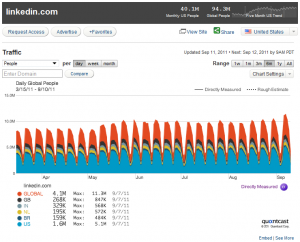
LinkedIn User Demographics and Visitor Statistics 2011

Would you like to know more about LinkedIn’s user demographics, as well as LinkedIn’s visitor statistics broken down by country, city, and state?

If so, you’ve come to the right place!

After patiently waiting for a whole year since my last post on LinkedIn statistics, I’m excited to bring you LinkedIn’s latest user demographics and visitor statistics for 2011.

In this post, I will compare the data I presented in September 2010 to the data I just pulled from Quantcast.

Quantcast is used by 9 of the top 10 media agencies because they quite accurately quantify Internet audiences.

While some sites are not directly measured and only have estimated data at this time (such as Facebook and Twitter), LinkedIn is fully “quantified.”

LinkedIn_Quantcast_Directly_Measured_Data

In other words, Quantcast directly measures LinkedIn’s visitors – which gives us great information and some very interesting insights!

Read on to see the following LinkedIn data:

  • Global monthly visitors
  • Global monthly visits
  • Visits per person
  • Pageviews per person
  • Visit frequency
  • Business activity
  • User demographics (gender, age, ethnicity, income, education level)
  • Monthly visitors by country
  • Monthly visitors by city (global)
  • Monthly visitors by state (U.S.) Continue reading

Talent Sourcing: Beyond Tips, Tricks, Hacks and the Internet

It’s bothered me for quite some time now that many people essentially equate sourcing with Internet search – using search engines such as Google and Bing to find resumes, lists, press releases, etc.

It bothers me because sourcing is so much more than that.

It also bothers me because I am aware that many companies (some quite large and well respected) limit their sourcers and recruiters primarily to the Internet as the only source of information.

I believe a major contributing factor as to why sourcing isn’t highly valued by some organizations and why sourcing doesn’t get as much widespread respect and recognition as it should is because too many people associate sourcing primarily with Internet search.

The future of talent sourcing will involve a shift from manual Internet search and ATS/CRM systems with only rudimentary search and analysis capability to highly specialized tools specifically designed for mining vast and proprietary human capital data sets dynamically compiled from multiple sources that enables predictive analytics.

It’s coming – will you be ready? Will you be ahead of the curve or behind it? Continue reading