Monthly Archives: February 2011

How to Use LinkedIn’s Advanced Operators as Search Agents


In January 2009, I wrote a feature about LinkedIn’s advanced operators. Two years later, I am still surprised that remarkably few people leverage the ability to bypass LinkedIn’s advanced search interface and “hand-code” search strings.

Before I demonstrate how you can use LinkedIn’s advanced operators as search agents, here is a quick refresher detailing the all of the advanced search operators:
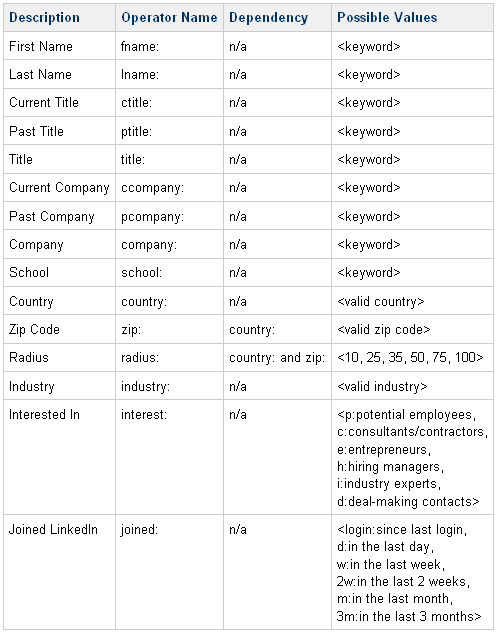
 

You can use these operators in conjunction with standard keyword search terms in the people search box.

In this quick example, I am targeting profiles with a current title of engineer and a current company of Google: Continue reading


Creating or Selecting Effective Sourcing Training: SourceCon NYC

Have you received any formal training on how to source candidates?

If yes – what kind of training was it? What was the format? What was the focus – syntax, techniques, sites? Who delivered it – a third party trainer or an internal resource? How was the content delivered? Was it effective? Were you tested or certified?

If you’ve never received any formal training on candidate sourcing – you’re not alone. When I asked the SourceCon attendees the aforementioned question during my presentation on the topic of creating or selecting effective sourcing training, by a show of hands, the majority had not received any formal sourcing training.

I’ve never had any formal sourcing training either – everything I know I learned the hard way, through trial and error and a simple determination to not fail and to get results.

Although certainly not ideal, figuring out how to do something by yourself isn’t actually the worst way to learn something. Aristotle (384-322 BC) once mused that “For the things we have to learn before we can do them, we learn by doing them.”

Before I delve into the training methods that have the highest amount of knowledge transfer, it is important to take a look at why it tends to be so difficult to effectively train sourcers. Continue reading

What is Lean Just-in-Time Recruiting?

JIT identification BW

The process of identifying an organization’s talent needs and identifying, acquiring, and retaining talent for those needs is essentially human capital supply chain management.

A supply chain is a system of organizations, people, technology, activities, information and resources involved in moving something of value (a product, a service, or a person) from a source to a customer/consumer.

Conventional supply chain activities transform natural resources, raw materials and components into a finished product that is delivered to the end customer.

In recruiting, human capital supply chain activities transform relationships and data (ad responses, resumes, social networking profiles, etc.) into candidates that are delivered to hiring managers.

So why is it that there is quite a bit of resistance to applying proven supply chain management principles and practices to human resources and recruiting functions?

Let’s take a look at how Lean principles and Just-in-Time concepts can and should be applied to recruiting. I’ll be covering this topic at TruLondon 3– so if you will be in attendance (live or virtually), this will be an excellent prep for you. Continue reading