Monthly Archives: April 2009

What is the Low Hanging Fruit in Recruiting?

If you’re a regular reader of my blog, you know I’m a fan of leveraging every information resource available to me – my internal ATS/CRM, the Internet, LinkedIn, Facebook, Twitter, and yes, even job board resume databases (gasp!).

Have you ever heard job board  naysayers refer to the resumes you can find on Monster, Dice, Careerbuilder, Hotjobs, etc. as the equivalent of “low hanging fruit?”

I know I have – MANY times.  When I hear people say it or read people write it, it always seems to be used with a negative connotation, and sometimes with derision

Is “low hanging fruit” intrinsically a bad thing? Is it even an accurate way to describe searching for resumes on the job boards? 

From what I can tell, “low hanging fruit” is a concept most people understand because they’ve heard others use it in context. But what does such a statement actually mean?  In this article, I will show you there are at least a few different takes on the meaning and use of the phrase and you may be surprised at what actually fits the bill as low hanging fruit in recruiting.  Continue reading

Is LinkedIn Becoming a Job Board?

Is LinkedIn a social networking site, a job board, or a little of both?

Most people consider LinkedIn to be a social networking site, or more specifically a professional network service. LinkedIn describes itself as an “interconnected network of experienced professionals.” However, when I take a step back and take an objective view of LinkedIn, I see a great deal of “job board” functionality with some social networking features.

Before you cry “blasphemy!,” let’s do some research and look at the facts. 

What Exactly is a “Job Board?”

I tried doing some research to find a definition of exactly what a “job board” is, and found that Wikipedia considers Monster, Careerbuilder, Hotjobs, Dice, etc. to be employment websites. According to Wikipedia, an “employment website” is “…a web site dealing specifically with employment or careers. Many employment websites are designed to allow employers to post job requirements for a position to be filled and are commonly known as job boards.”

Common Features of Job Boards

According to INTERNET Inc, “job boards are usually free for job seekers though there are some exceptions mostly in the realm of upper management and executive jobs. Job ads can usually be found by browsing or through search on keywords, job type and location. Employers usually pay a fee to post job ads… Most job boards also offer employers resume database access for searching out candidates that match specific criteria. Additional services offered by job boards to employers often include: job agents that alert recruiters by e-mail to newly published job seeker resumes that meet specific criteria, …and brand building advertising with e-mail campaigns, banners, buttons and company profiles.”

What LinkedIn Says About LinkedIn

I did some digging and found LinkedIn’s press site. Under the heading of “What is LinkedIn?,” you can read that “When you join, you create a profile that summarizes your professional expertise and accomplishments.” Continue reading

Don’t Be A Sourcing Snob

Are You a Sourcing Snob?

Ask yourself these questions:

  • Is a candidate identified on LinkedIn intrinsically “better” than a candidate sourced from Monster?
  • Is candidate sourced by cold calling inherently “better” than a candidate sourced from a job posting on Careerbuilder?
  • Does it really matter where a great candidate comes from?

I continue to see well respected thought leaders in the staffing industry make claims that the quality of candidates on the job boards is low, and there seems to be no shortage of those in the recruiting and staffing industry who are happy to jump on that bandwagon. However, whenever I read or hear broad, sweeping statements claiming that an entire population of 50,000,000+ candidates is low quality just because they happen to be in an online resume database of a major job board – my response is a mix of shock and disappointment. 

Stereotyping is Poor Judgement

Broad statements such as “the job boards have low quality candidates” reeks of stereotyping.  A stereotype is an oversimplified conception or opinion based on the assumption that there are attributes that members of the “other group” (in this case, job board candidates) have in common. Stereotypes are often formed by an Illusory correlation , a false perception of an association between two variables where in fact none exists.

You just can’t go around claiming all job board candidates are bad. That’s like saying everyone in New York is rude, or that everyone in California is a hippie. To stereotype all job board candidates as low quality is downright insulting to the many fantastic people who make the decision to post their resume to well known online resume databases. If they only knew that posting their resume to a job board was equivalent to moving to “the wrong side of the tracks.”

Sourcing Snobbery

Many sourcers and recruiters use the Internet to source and identify candidates all the time, yet there is never a mention of the intrinsic “quality” of candidates who happen to post their resume on their own websites. As if creating a website and posting your resume to it somehow makes you a better person than someone who either doesn’t know how do do that or simply doesn’t care to, instead opting to post their resume to a well known job board site.

And what about Social Media? The last time I checked – there is no “candidate quality filter” built in to LinkedIn, Facebook, Twitter, or any social network. ANYONE can decide to create a web page or a Social Media profile, from “A” players to “F” players. Continue reading

Searching Social Media Requires Outside-the-Box Thinking

Non-Standard Descriptors and the Role They Play in Social Media

Article by Valerie Scarsellato, Sr. Sourcer at Intel Corporation
Co-written by Glen Cathey

Sourcing has always been a significant component in the recruiting lifecycle. However, in recent years, sourcing has taken a giant step into the forefront and has become recognized as the solid foundation at which successful recruiting rests upon in order to identify and secure top-level talent, no matter what industry you may be supporting.

One of the newest tools available for sourcers and recruiters to leverage to find candidates is Social Media (SM). These days, it seems as if nearly everyone from CEOs of Fortune 500 companies, to inventors in various fields, to the grandmother of your best friend has a Myspace or Facebook page or a LinkedIn or Twitter profile.

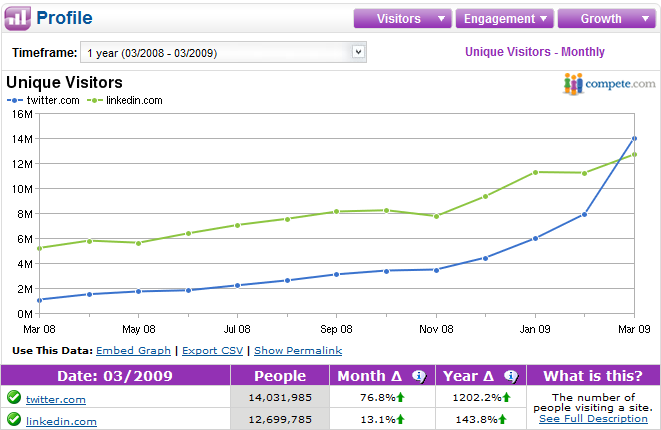
Twitter happens to be my personal preference in the SM realm. It also happens to be the fastest growing Social Media application at 1200% in the past year!

Although some people are still discovering and testing the waters of the Twitterverse, a diverse and large population (over 14M visitors in March – surpassing LinkedIn!) spanning nearly all industry segments has already fully jumped on to the real-time messaging bandwagon in order to share information or blurt out a piece of nonsense rolling around in their head.

Understand Social Media Users

With the significant levels of attention and traffic being driven by Social Media, it’s critical for sourcers and recruiters to understand how to best utilize SM for talent identification. Technology is ever-evolving and those of us in sourcing/recruiting/talent acquisition roles (even we have many titles!) are constantly having to play catch-up with those that create each new SM application.

After attending one of Glen’s focused and information-packed FREE webinars, I had an epiphany. It’s true – we need to build the right search strings in order to filter through and find the right people we are targeting. In order to do that effectively, I realized that we as sourcers need to understand the psychology of the people we’re searching for and be aware of how they think of and refer to themselves in order to return highly relevant results when searching Social Media. Continue reading

How to Search Twitter for Sourcing and Recruiting

It appears that many people in the sourcing, recruiting, and staffing industry are all a-twitter about Twitter these days. My professional opinion is that Twitter is best utilized for personal and corporate branding, as well as socializing job opportunities – in other words, PASSIVE sourcing and recruiting techniques.

However, even if you’re a Twitter-hater, you cannot deny the buzz and the traffic that Twitter has been generating (1200% YOY growth). Also – did you know that Twitter just surpassed LinkedIn in terms of unique U.S. visitors in March? As such, it would be foolish for sourcers and recruiters to avoid trying to figure out how to best leverage the 14 million+ Twitter users to identify potential candidates.

Using Twitter for Active Candidate Identification

If you’ve ever found yourself wondering if you should and how you can leverage Twitter in your ACTIVE talent identification efforts, you’ve come to the right place.

While Twitter is an intrinsically shallow source of human capital data (140 character Tweets and 160 character bios), unlike Facebook – it is quite searchable. In this post I am going to review and compare 6 effective methods of searching Twitter for ACTIVE candidate identification: Twitter’s Advanced Search, Power Twitter, TweetDeck, Twellow, TweetGrid, and X-Ray searching Twitter – including 5 video walk-throughs of how to maximize your searching efforts with each application. Continue reading